Your CVE backlog is not shrinking. Your Authority to Operate timeline is not getting shorter. And your FIPS and STIG requirements are not going away. If you are running federal or regulated workloads, you already know the pain: there are no compliant commercial off-the-shelf container images, auditors keep flagging the same CVEs, and your Plan of Action and Milestones list grows faster than your team can close items. Automated vulnerability remediation is not optional at this scale. It is the only way to keep pace.
This post breaks down what teams get wrong, what to look for in a solution, and how to run a practical remediation program against a FIPS and FedRAMP baseline.
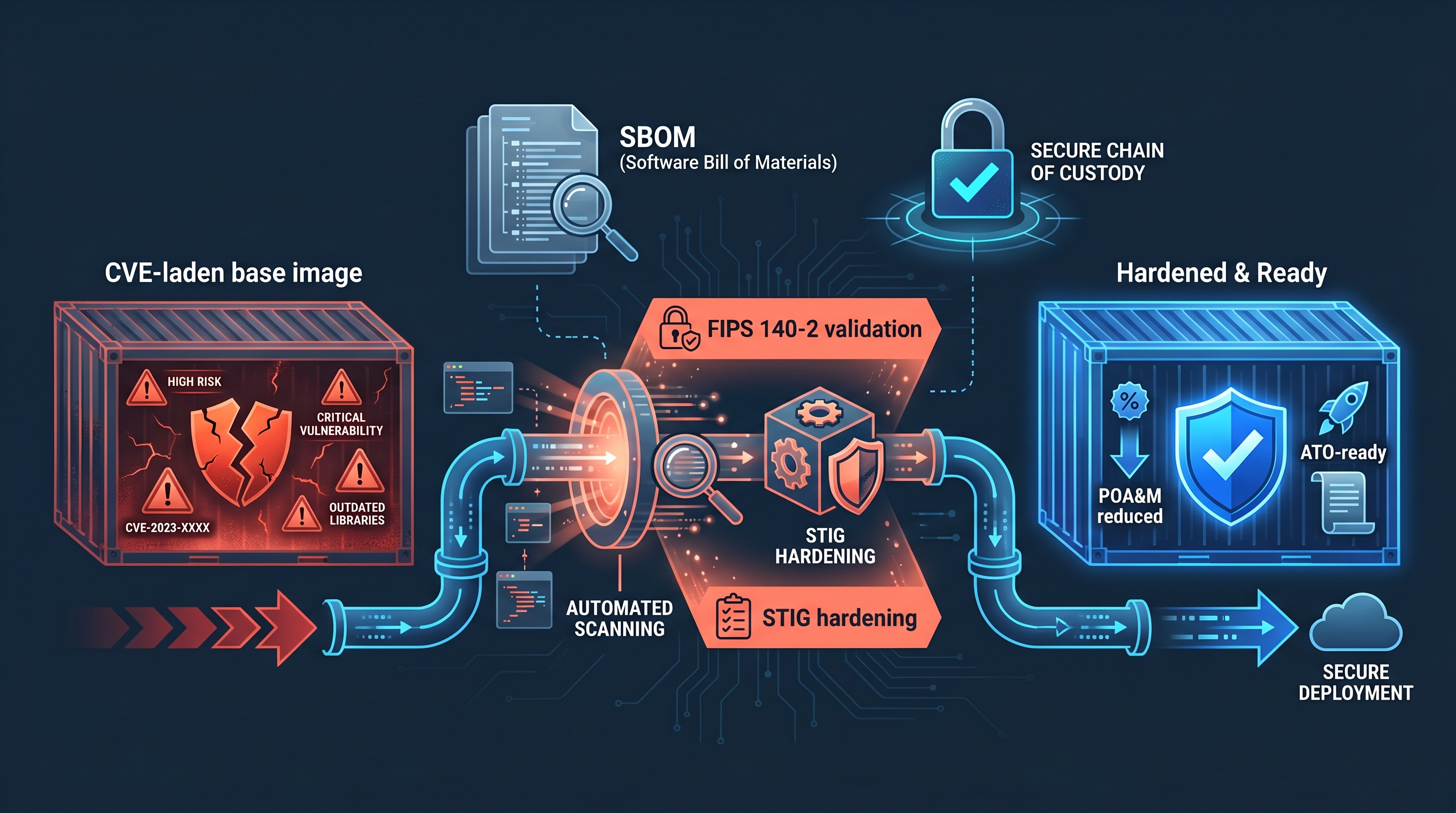
What Teams Get Wrong When Hardening for Federal Compliance
They treat hardening as a one-time event. STIG checklists and FIPS validation are not checkboxes you mark at ATO and forget. New CVEs emerge daily. Configurations drift. A container image that passed a scan in January may carry critical findings by March.
They conflate FIPS compliance with FIPS validation. A library can claim FIPS mode without carrying a validated module certificate. Auditors check certificate numbers, not configuration flags. If your crypto stack is not covered by a NIST-approved validation, you are not compliant regardless of what the documentation says.
They try to patch upstream base images manually. Alpine, Debian, UBI, and Ubuntu LTS base images are not pre-hardened for federal use. Teams spend weeks applying STIG controls by hand, running scanners, generating findings reports, and looping back through the same controls when a new CVE invalidates a prior fix. That cycle does not scale to a 12-to-18-month ATO timeline.
They undercount the attack surface. Unused packages, shell utilities, and dynamic libraries that ship in a standard base image are not required for most workloads. Every unnecessary component is a potential finding. Reducing attack surface before scanning produces a cleaner SBOM, fewer POA&M items, and faster reviews.
"The CVE inventory is the number one audit finding across federal container deployments. Most of those CVEs live in packages the application never loads at runtime."
Criteria Checklist: What to Require in a Federal Container Security Solution
FIPS 140-2 or 140-3 Validated Cryptography
Any solution operating in a federal environment must use cryptographic modules covered by a current NIST Cryptographic Module Validation Program certificate. Verify that the validated module, not a wrapper around it, handles encryption, hashing, and key management for your workload. The cost of getting this wrong is a FISMA finding and a delayed ATO.
STIG and CIS Hardening Baked In
Pre-applied STIG and CIS controls reduce the delta between a default image and your baseline. Look for images where hardening is documented, repeatable, and tied to a specific STIG version. Manually applying hundreds of controls per image per update cycle is a staffing problem that most platform teams cannot absorb.
Automated CVE Remediation at Scale
Automated vulnerability remediation means the tooling removes or replaces vulnerable components without requiring you to rebuild from scratch, rewrite pipelines, or maintain custom Dockerfiles per image. Evaluate whether the vendor updates images continuously as new CVEs are published, not just on a monthly release cycle.
Runtime Profiling to Minimize Attack Surface
A runtime bill of materials tells you which packages a container actually loads during execution. Tools that generate this profile let you safely remove unused components before they become findings. This directly reduces the number of POA&M items auditors raise and cuts the scope of your continuous monitoring obligation.
Drop-In Compatibility with Your Existing Stack
Hardened container images should be substitutable for standard base images without changes to application code, OS configuration, or CI/CD pipelines. Rearchitecting to adopt a security tool compounds risk during an ATO sprint. Require that the vendor demonstrate drop-in replacement for Alpine, Debian, UBI, and Ubuntu LTS variants.
Availability Through Federal Acquisition Channels
FedRAMP-Ready posture, availability on Platform One, and listings through procurement vehicles like Tradewind or Carahsoft reduce acquisition friction. If a tool requires a novel procurement path, budget at least a quarter for contracting. That time is better spent closing POA&M items.
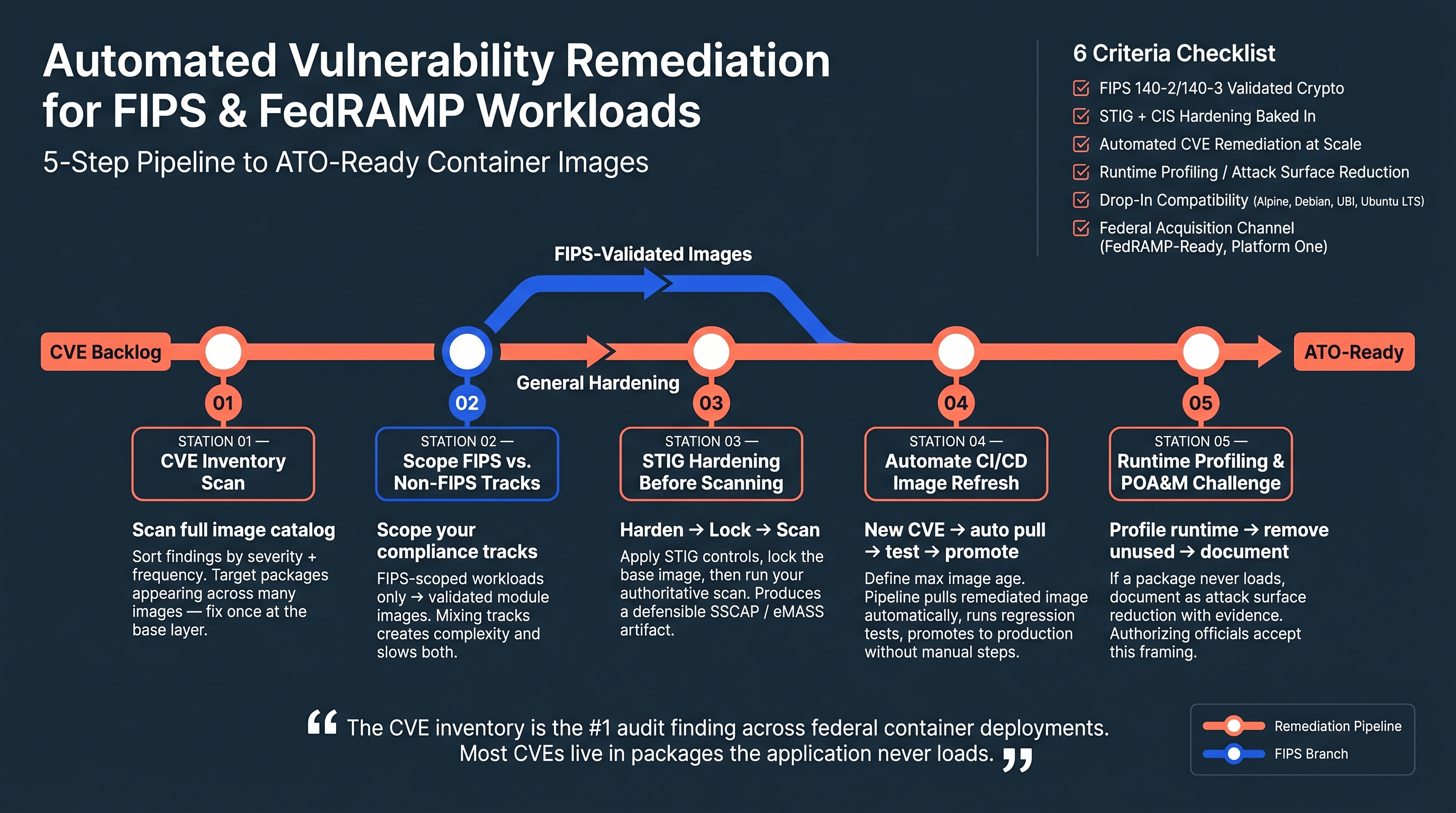
How to Run Automated Remediation Against a FIPS and STIG Baseline
Start with an honest CVE inventory across every image in your registry. Run a scanner against your full image catalog before you do anything else. Sort findings by severity and by package frequency. Packages that appear across dozens of images and carry high or critical CVEs are your highest-leverage targets. Fix them once at the base image layer and every downstream image benefits.
Separate FIPS validation concerns from general hardening. Audit which workloads are in scope for FIPS requirements and which are not. Only FIPS-scoped workloads need validated module images. Mixing requirements creates unnecessary complexity and slows both tracks. Maintain separate image pipelines for FIPS and non-FIPS workloads from the start.
Apply STIG controls before scanning, not after. Scanners report against a baseline. If you apply STIG hardening to a pre-scanned image, you will rescan and get different results, invalidating prior documentation. Establish your hardened base image, lock it, then run your authoritative scan. This produces a clean, defensible SSCAP or eMASS artifact.
Automate image updates in your CI/CD pipeline and treat the refresh cadence as a compliance control. Define a maximum age for a production image. When a new CVE is published against a package in your base, the pipeline should pull a remediated image automatically, run regression tests, and promote to production without manual intervention. This turns continuous monitoring from a reporting exercise into an operational practice.
Use runtime profiling data to challenge your POA&M. Not every CVE in a scanned package represents an exploitable condition. If runtime profiling shows a package is never loaded, document that in your POA&M with supporting evidence. Authorizing officials increasingly accept this framing, and it reduces the remediation burden on your team without compromising the security posture.
Frequently Asked Questions
What does FIPS 140-2 validation actually require for a container workload?
FIPS 140-2 validation requires that cryptographic operations within the module boundary use software or hardware covered by an active NIST certificate. For container workloads, this typically means the base image must ship a validated OpenSSL or BoringCrypto module and the application must be linked against it. General OS hardening and CVE patching are separate concerns from FIPS validation, though both are usually required for FedRAMP authorization.
How do STIG hardening and FIPS requirements interact in a container environment?
They are complementary but independent baselines. STIG controls address configuration security: file permissions, unnecessary services, logging, and access controls. FIPS requirements address cryptographic module validation. A container can be STIG-hardened without using FIPS-validated crypto, and vice versa. Federal workloads seeking ATO typically need both applied simultaneously, which is why teams that build pre-hardened images combining both baselines, like those available through RapidFort, can shorten the ATO timeline compared to applying each baseline manually.
How do I justify removing packages to my authorizing official?
Runtime profiling provides the evidence. If you can show that a package is installed but never executed during normal operation, you can document it as an attack surface reduction measure rather than a deviation. Most authorizing officials accept this with a signed risk acceptance or a note in the security assessment report. The key is documented evidence, not an assertion.
What should I do with POA&M items tied to packages I cannot immediately remove?
Prioritize by exploitability, not just CVSS score. A critical CVE in a network-facing package loaded at runtime is higher priority than the same score in an offline utility. Set a remediation timeline, document compensating controls such as network segmentation or least-privilege execution context, and update the POA&M at your defined continuous monitoring frequency. Letting items age without status updates is the fastest way to stall a reauthorization.
The Cost of Standing Still
Every month you defer systematic remediation, your CVE count grows and your audit findings multiply. Auditors do not grade on a curve. A POA&M with hundreds of open items signals an immature security program regardless of how good your policy documentation is.
Manual STIG hardening and manual CVE patching are not repeatable at the image volume modern platform teams manage. The labor cost compounds with every new service, every base image update, and every new STIG version. Teams that try to hold this baseline manually end up with stale images, deferred findings, and missed reauthorization windows.
The 12-to-18-month ATO timeline that plagues federal programs is not entirely a process problem. A significant portion of that time is consumed by remediating findings that could have been prevented with better base images. Reducing your CVE and configuration finding count before the assessment begins is the highest-leverage investment you can make in your ATO schedule.
FedRAMP and FISMA are not going to get less strict. FIPS requirements are expanding, not contracting. The teams that build automated, repeatable remediation pipelines now will have a compounding advantage at every reauthorization cycle. The ones that wait will keep fighting the same audit findings year after year.